


Scopophilia, or voyeurism, is one of those psychological concepts with a strong and meaningful bond with cinema. Hitchcock’s Rear Window, Michael Powell’s Peeping Tom and Tornatore’s Malèna are only a few familiar examples among the many films that have dealt with this psychoanalytic idea.
In Parallel Tales, Asghar Farhadi changes something fundamental in his own way of storytelling. At the same time, and with considerable subtlety, he changes the position of voyeurism within that storytelling. The first voyeur we meet is a writer, Sylvie, played by Isabelle Huppert. She has neither the attractions usually attached to a young woman in such a setup, nor, like the energetic boy in Kieślowski’s A Short Film About Love, the adolescent need to spy on an attractive woman across the street. Beyond all these familiar and arranged attractions, she holds a much more important position in society: she is a writer.
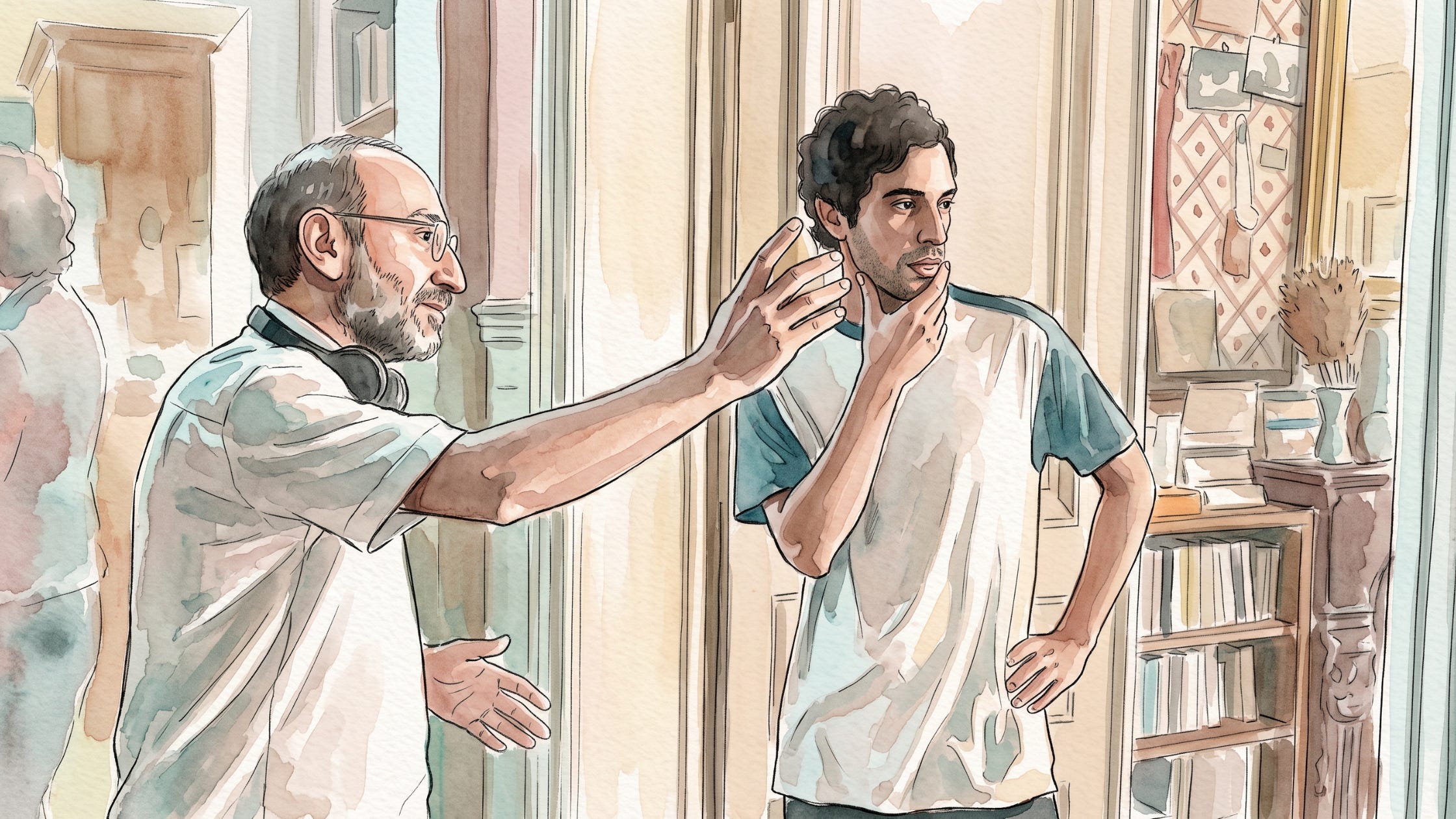
Through the society he builds in the film, Farhadi repeatedly insists that a society in transition, caught up in today’s most basic ethical questions, needs a writer who creates and crosses boundaries. Someone who makes people come back to themselves and experience crises that, buried under everyday concerns, might never even enter their minds.
Then, when a potential hidden inside them finally appears, they may feel something close to shame before the person they could have been, but until that moment had never had the chance to become. This is the ruthless nature of the writer Farhadi draws.
Sylvie knows people well enough to understand that, to write what may be her last work, she has to start watching them. Her lived experience then mixes with what she sees today, and something can be created from the two.
It is easy to see a metatextual trace here of the case surrounding Farhadi’s previous film, A Hero, and the allegations of possible artistic plagiarism, in this game between creator and forger. By the time the film ends, if we accept Adam, played by Adam Bessa, as a writer, it is no longer easy to decide whether he is a better writer than Sylvie. We may even begin to imagine that Sylvie herself once became a writer through a similar game.
One of the important things Farhadi seems to be saying that what matters is the creation of a story in the mind. Once you have gone far enough into that story, the whole world you have created belongs to the person who has carried it to that point.
Adam is the one who brings Sylvie’s discarded story back to life in order to become a writer. He uses it as a reason to connect with people in society whose way of living is far removed from his own. This is also how an artist can portray the concerns of his own life as they happen to him, in a sense acquit himself through the work, and invite the audience to watch something original coming from his own mind and experience.
The shift of the voyeur from Kieślowski’s young man to an older woman looking for material for a story, however, becomes more than a simple game of replacing one character with another.
In this newly built world, Farhadi does with his characters something close to what he has done before. He seems to create two worlds, in a way that recalls Hermann Hesse’s Demian: those who live in the bright world, the masses or the others, and those who live in the dark world, the awakened or the marked.
The marked are the ones who stand behind the telescope and make stories out of what they see in the bright world of the masses. It seems that this kind of gaze is not available to everyone. Early in the film, a young boy is stopped from using the telescope.
Later Adam gains access to it, and finally Nita, played by Virginie Efira, reaches this lens through which the world can be watched. For a moment, they seem to become rulers of the world below them.
But Parallel Tales shows that this division between above and below eventually reaches a point where those above, who apparently have the power to change the world, also enter the world below, the bright world. And there, like everyone else, they are condemned to live with their own traumas and psychological wounds.
The clearest meeting of these worlds comes when Pierre, played by Vincent Cassel, meets Sylvie at the lowest level of this social structure, below both the bright and dark worlds, on the ground floor of the building.
The writer meets one of her imaginary characters in the real world and challenges him. The scene itself is an example of how precisely and deeply a writer can define a character. Sylvie asks Pierre:
“If it isn’t real, then why did hearing it upset you?”
This is the point where the creator lays out her whole anxiety about making a story that does not correspond to the real lives of people.
It is also here that she understands Adam’s experience and becomes his mother, taking exactly the position Adam had imagined for Sylvie in his own story.
So there is at least one rule that seems certain inside these tangled fictional and real worlds: whatever takes shape in your mind can happen in the world. With imagination alone, you can put a real duck inside a real bottle.
The dialectic between reality and fiction could not have been built in this film without editing that stays closely connected to its central idea. As usual, Hayedeh Safiyari’s precise understanding of Farhadi’s material turns the editing into one of the film’s strengths.
A simple, exact cut from what is happening inside the studio to Sylvie’s typewriter, as she moves to the next line, is enough to place the idea of Sylvie’s created world in the audience’s mind. Until the film gives us another sign, that assumption remains firmly there.
Vincent Cassel said in an interview at Cannes that Farhadi had turned them into Iranians.
The remark can also be read as something about the nature of acting itself. Actors are supposed to enter the bodies and lives of other people. For the actors of this film, living like Iranians in the heart of Paris could have been an opportunity for a kind of creation that cinema has not offered to many performers.
The film’s biggest weakness, though, is perhaps its flashback sequence. It belongs neither to Farhadi’s way of storytelling nor to the film’s references to Kieślowski.
More generally, showing exactly how a trauma was formed in a character’s past is something filmmakers committed to the kind of modern cinema associated with Bergman and Antonioni rarely choose to do. In Parallel Tales, the sequence feels like something attached to the film from outside.
And it leaves behind an important question: if Farhadi had not shown us this image, and had instead allowed the audience to build its own image of the trauma, would the world of the film have become more coherent?
Parallel Tales shows that Farhadi still has his gift for storytelling and for looking deeply into his characters. Now, with a rare opportunity in his filmmaking career, working in Paris with some of the major actors of world cinema, he has chosen to put that gift under pressure and test it against the present moment.
Putting established formulas back on the table and testing them has had consequences too. Perhaps the most important has been the limited attention the film received from European audiences.
From what I witnessed at Cannes in 2026, much of the festival audience expected something else from Asghar Farhadi.
For me, the filmmaker’s biggest gamble was making the narrative structure more complicated. It may have given Farhadi an exceptional experience as a filmmaker, but it also seems to have cost him a considerable part of the audience that had followed his previous work.
Still, the courage involved in taking that artistic risk, and in changing the direction of his filmmaking, should also be counted in Asghar Farhadi’s favour.
