


Somewhere in Amsterdam this week a person with a watermelon pin on a tote bag will sit down to a film in which the watermelon turns out to be Israeli. I would pay to see the face. The stall is in Jenin, the fruit is stacked like a still life, and the vendor says without any drama that it comes from the settlements. I come from a country that takes its watermelons seriously, so I sat up. Jenin used to send its own to Beirut, Damascus and Amman, and now it buys the emblem of its cause back at market price.
The film is Serene Husni’s Jenin & the Nakba Between Us, showing in IDFA’s Frontlight section, and it took her ten years. Husni was born in exile to a Jenin family, lives in Toronto and has no Palestinian ID. In 2016 she swallowed her pride, asked the people who expelled her grandfather for a visa, and entered her own country as a tourist. In May 2023 she went back, and this time she gave up hunting for her father’s memories and asked the people who live there what she was looking at.
At the bus station she asks about a bus to Haifa and is told she’d have to cross on foot. A boy on his way to school stops to explain why two houses in his village are rubble (military zone), and she sends him off before he’s late. Mashal Kawasmi’s camera stands still and waits, which in a place full of drones counts as good manners. Majd Sukar’s music is never far off, racing in one scene and nearly still in the next, and it carries the pictures along. The sound stumbles here and there. Under these conditions I can’t hold it against the crew.
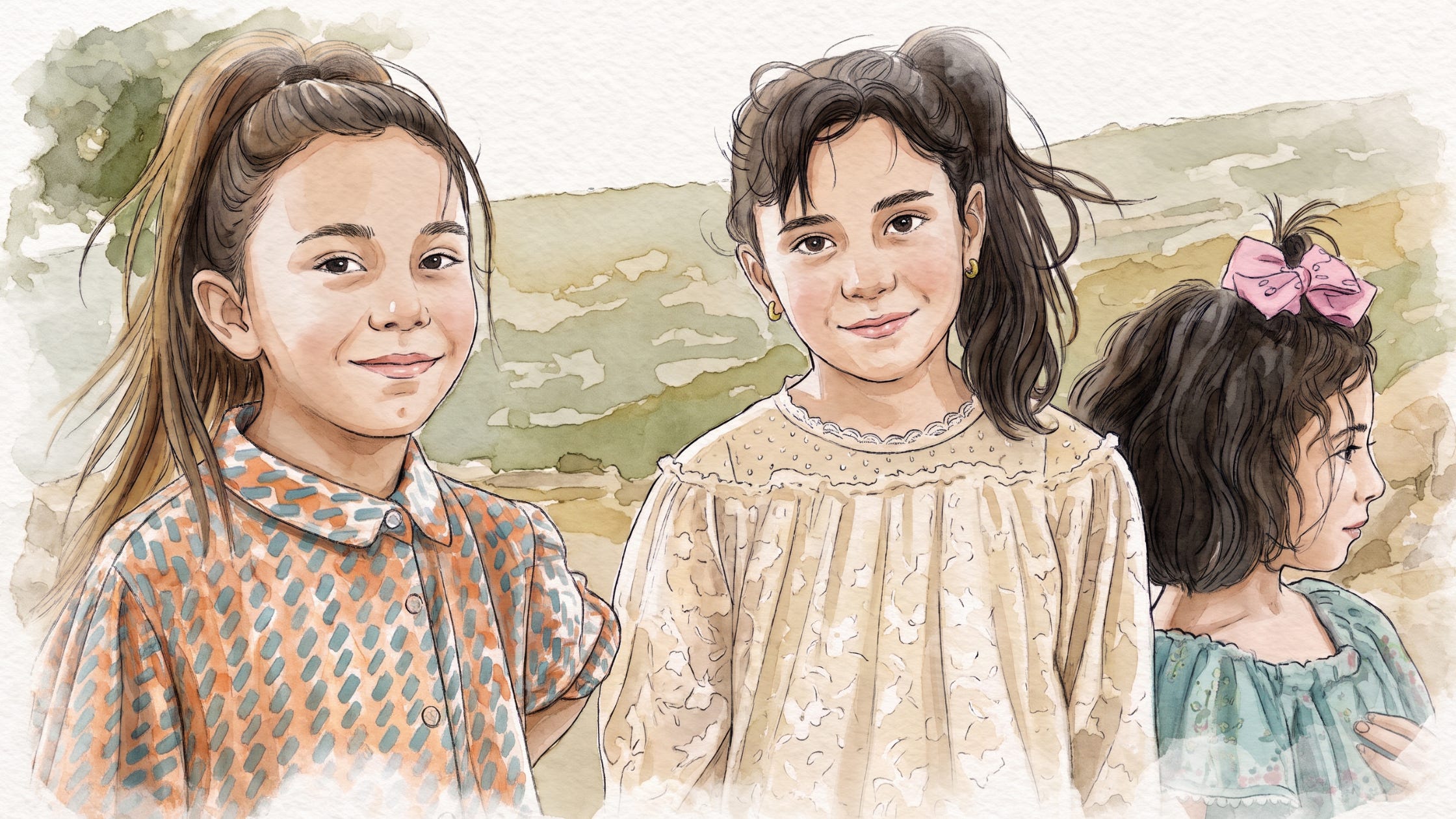
Over all this Husni speaks from the present, and the present is Gaza. She tells us near the start that she is writing in a time of genocide and no longer knows how to give these pictures a beginning and an end. It is why I can joke about tote bags and find none of it funny. She is a little too fond of asking how a scene should be read, but mostly what she has to report is that the thing we are looking at no longer exists. The horse built from the wreckage of the 2002 invasion was carted off by soldiers one Sunday in October 2023, and the refugee camp next to it would be emptied within a year and a half. I can’t think of another documentary whose commentary works as an obituary for its own shots.
Follow the watermelon, though, and you get the lecture on political economy I have never quite managed to give in a classroom. Out on Marj Ibn Amer a farmer explains how it works. Every year, just as the Palestinian crop comes in, cheaper and poorer Israeli melons land in the market and undercut it, and every year it gets a little worse. He has been planting for thirty years and goes on planting at a loss, out of what he calls stubbornness. In the next field they grow cucumbers, picked small because the pickle factory on the other side wants them small. The film sums it up in a single subtitle, which I have stolen for my headline. Marx needed a great many more pages to say the same thing.
If you want to know what a captive labour market looks like, it looks like the Jalameh checkpoint at 4.28 in the morning, men queuing in the dark with their lunch and their work permits. And if you want to know what the peace process built, look at the farmland the Palestinian Authority fenced off for a free industrial zone, under construction for more than ten years. The occupier takes the land and the water. The Authority takes the brochure. Husni films all of it without raising her voice, and that restraint is the best thing about her film. You start doing the arithmetic yourself.
Which is why I wish she had followed the watermelon all the way home. Early on, Husni tells us that her great-grandfather was the mukhtar of Rummanah and owned great stretches of this plain, and she uses the word feudal herself. Later we learn the family took a third of the harvest where custom allowed two. I laughed out loud. Exploitation at a discount!
And the famous melons that went to Beirut came out of that third.
I say this as someone on her side. Most diaspora films arrive carrying a grandmother’s key and no account book, and it takes some nerve to open the book on camera. But she closes it again almost at once. Those peasants had grandchildren too, and I kept wondering whether they were the ones bent over the cucumbers, or queuing at Jalameh at 4.28. The Nakba of the title lies between Husni and Jenin, between the people who were pushed out and the people who stayed. Doesn’t it also lie between the landlord’s great-granddaughter and the sharecropper’s great-grandson? For that conversation the film has plenty of warmth and no questions. The nostalgia of exile is partly the nostalgia of people who used to collect the rent. Nobody chooses a great-grandfather, and perhaps I am asking a first feature to carry too much. Still, it is a place to stand a camera, and she never quite stands there.
The refugee camp is harder to write about. It is the reason the world knows the name Jenin at all, and it turns up after an hour, introduced by a committee chairman in front of a blackboard. Then the music picks up and we are in a crowd of masked men with rifles, at a memorial for a seventeen-year-old whom soldiers chased through the camp and shot dead the year before. Husni says they ended up there by chance. I believe her, because I was as startled as she was.
What I felt was unease. Some of it must be the baggage those images carry by the time they reach people like me, and some of it is just not being used to them. But where war has become part of daily life the rifle becomes part of it too, and after a minute the scene settles into an ordinary sort of strangeness. I wish Husni had stayed inside that strangeness a little longer and told us what she made of it.
IDFA, meanwhile, lists the film under a pathway called Resist!, exclamation mark included. In Jenin the rifle is part of the street. It takes a festival to give it punctuation.
The ending forgives a lot. On a hilltop outside Jenin, where a settlement stood until 2005, a family from town has driven up with a pot of stuffed vine leaves and a watermelon to watch the sun go down. One of the women is sixty-three and has never been up here before, though it is inside her own district. Husni tells us the settlers are coming back to these hills. Then the credits roll over a harvest, men throwing melons from hand to hand while somebody sings. I don’t know whose field it is, or who keeps which share. I’d like to. Maybe that’s her next film.
Jenin & the Nakba Between Us (2026) is an 89-minute documentary written and directed by Palestinian filmmaker Serene Husni. A Canada-Jordan production, the film follows Husni’s return to her family’s hometown of Jenin in the occupied West Bank, combining personal archives with conversations about displacement, agriculture, land ownership and everyday life under occupation.
The film had its world premiere at IDFA 2026 in the Frontlight section. Its first festival screening took place on 16 November in Amsterdam, with further screenings scheduled through 22 November.
Official Film Page: IDFA website
Production: Lost Time Media and The Imaginarium Films
Editor’s Note
Abbas Souzian: I believe film criticism should make room for different voices and independent perspectives. Reviews published in Souzian Dispatch reflect the personal views and interpretations of their authors.
As editor, my role is to respect each writer’s voice while maintaining our standards of accuracy and fairness.
You can explore more independent reviews in our Film Criticism section.
