


When I was at school, whenever we were asked to draw something, I usually drew streets, houses, courtyards, and small shops. Most of these drawings came from the neighbourhood where I had lived until I was four. They were simple, two-dimensional drawings, but I wanted to show others those places as I remembered them. Back then, it never even occurred to me that I could take photographs and show people what those places actually looked like.
Years later, while covering DOK Leipzig 2026, I came across “in memory of”, a short documentary by Florinda Ciucio. In the film, Mohammed Alimrani, a Palestinian artist from Gaza, tries to draw the streets, houses, and shops of his hometown from memory.
I was drawing places I remembered from childhood. Mohammed, however, is returning to a city where war has destroyed many of the streets, homes, and buildings he once knew. His drawings also carry personal memories, from neighbourhood shops to a café that was once part of his love story.
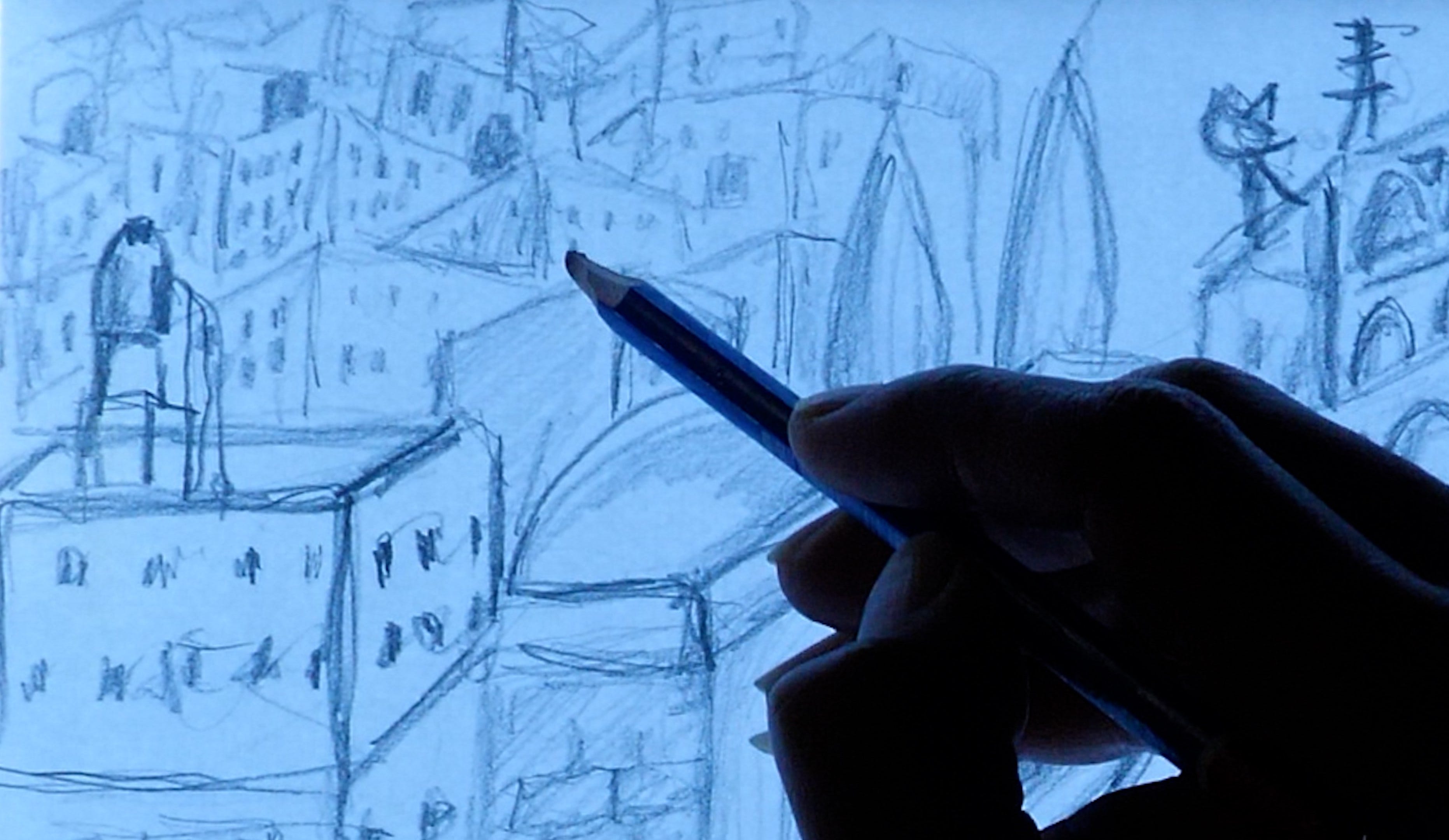
In this 14-minute documentary, Belgian artist and filmmaker Florinda Ciucio focuses on Mohammed’s hands, the lines of his pencil, and his voice. Mohammed reconstructs these places from memory, while Ciucio follows that process through film.
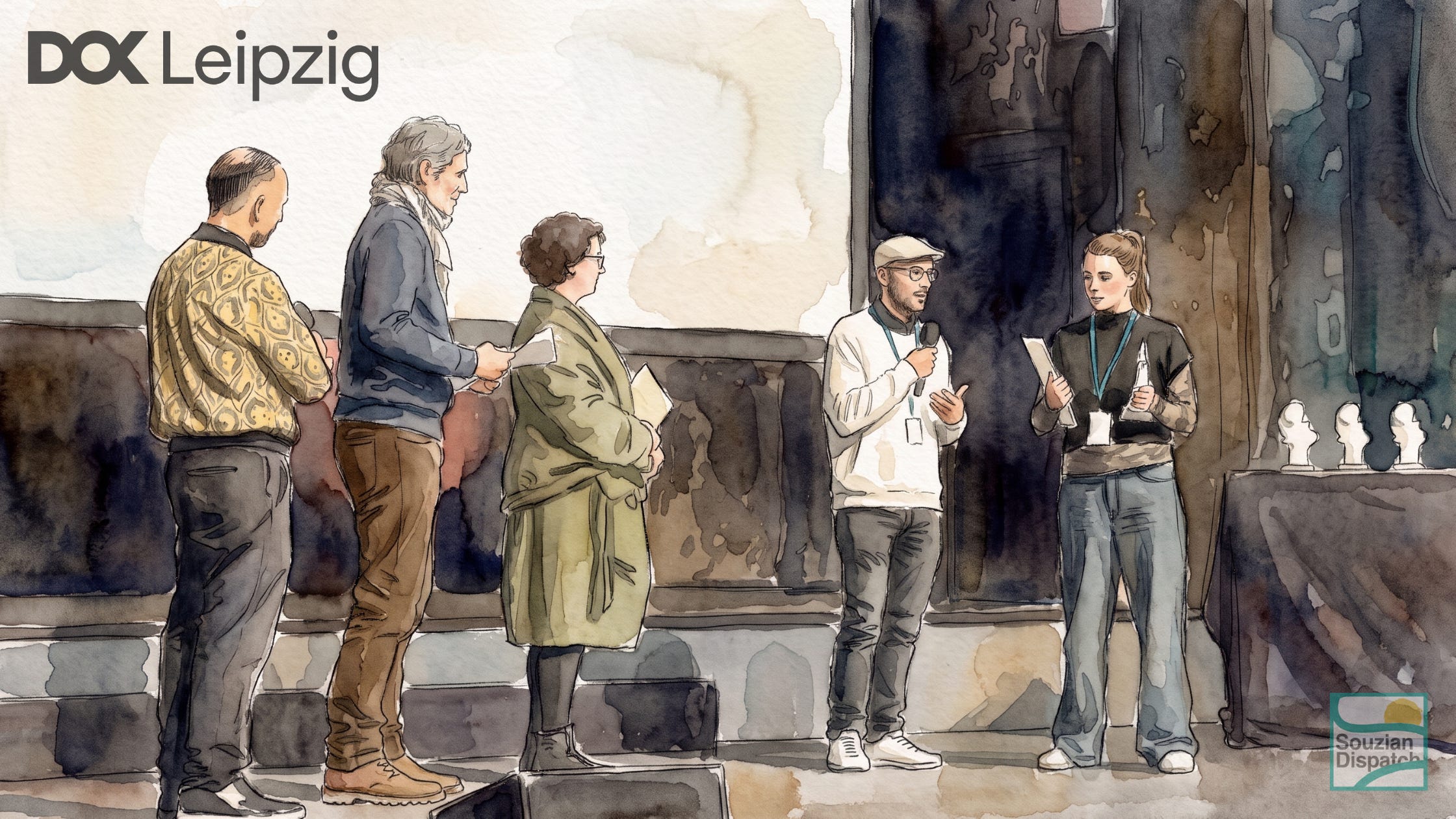
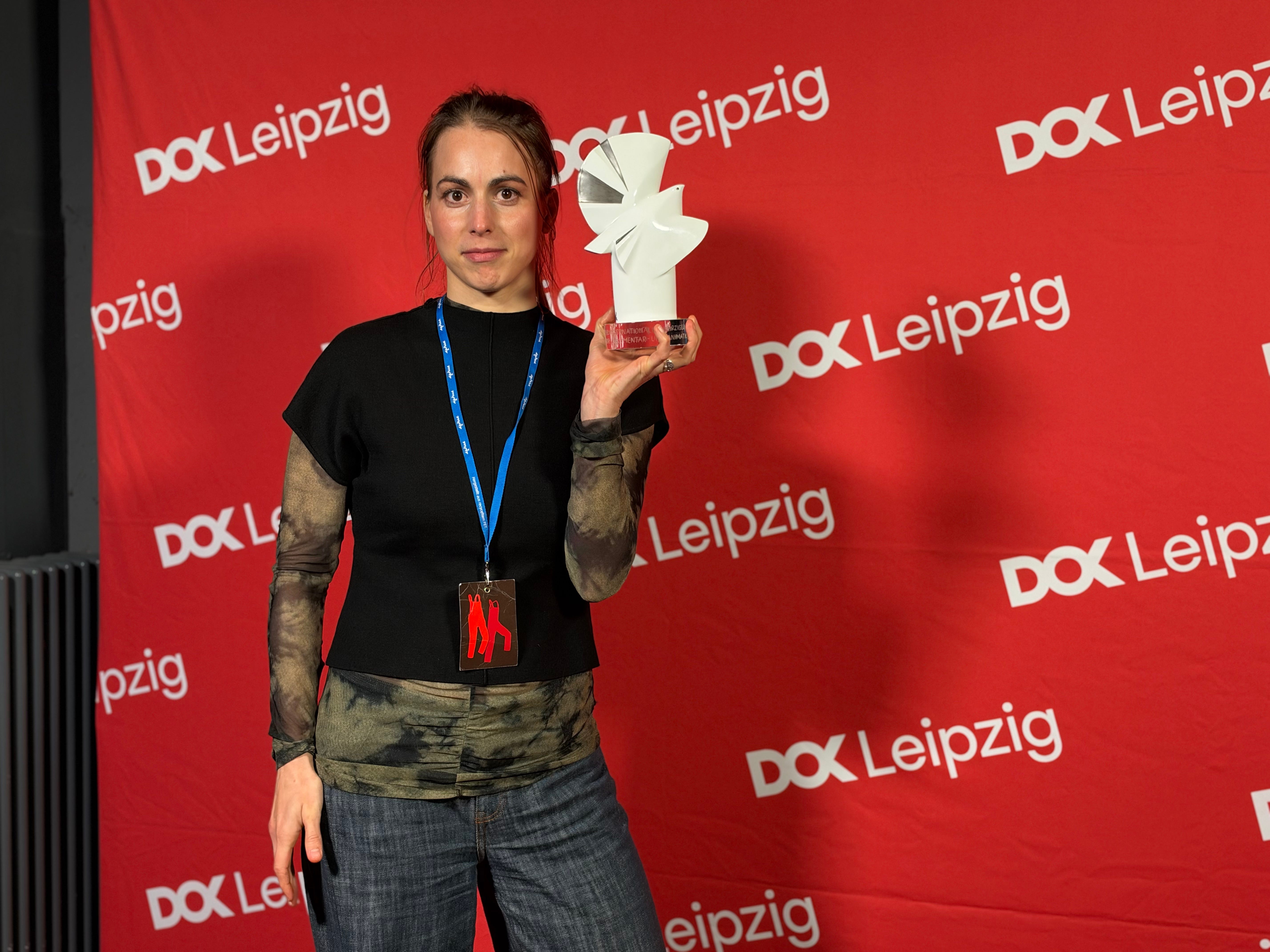
in memory of had its world premiere at DOK Leipzig 2026, where it received the Silver Dove in the International Competition Documentary Film.
In the following interview, I speak with Florinda Ciucio about how the film began, her collaboration with Mohammed, and the attempt to preserve memories of places transformed by war.
Abbas Souzian: I’d like to start with Mohammed. When did he leave Gaza? Was it before the current war began? And could you tell me a little about his background as an artist?
Florinda Ciucio: I believe he left Gaza in 2022 when he came for the artist residency in Cité Internationale des Arts in Paris, and stayed afterwards in France. He went to art school for two years I think, before dropping out, but I’m not really sure about the details. Best to ask him!
Mohammed Alimrani (in a follow-up message): Yes, that’s correct. I came to Paris in 2022 for an artistic residency at the Cité Internationale des Arts, supported by the Institut français of Jerusalem and the Palestinian Ministry of Culture. After completing my residency, I decided to remain in France and continue developing my artistic practice here.
Regarding my education, my background includes studies in both visual arts and theatre.
I studied Design at the University College of Applied Sciences (UCAS) in Gaza between 2010 and 2012, where I obtained a diploma in Design.
I also completed two years of theatre studies at the International School of Arts in Athens, Greece, and received a theatre diploma. My studies and experience in theatre have played an important role in shaping my artistic approach, particularly in relation to the body, movement, space and performance.
Later, in 2022, I also obtained a Diploma in Artistic Painting from the École Internationale des Arts de Paris. Unfortunately, my original Design diploma and many of my personal documents were lost when my family home in Gaza was destroyed in 2023.
Abbas: How did you and Mohammed meet? Who first came up with the idea for the film? Was Mohammed already drawing places from his memories of Gaza before you started working together?
Florinda: We met at the artist residency Cité internationale des Arts in Paris in 2022. He was doing a residency there as a painter and me as a film and video artist. We both stayed living in France afterwards for some time and had some friends in common, seeing each other once in a while. But it wasn’t until the end of 2023 and the beginning of 2024 where we went to some demonstrations together in a group that afterwards I thought: is there something more we can do to not feel so helpless against this terrible destruction of Gaza that we are all witnessing on social media. I knew Mohammed was a very skilled figurative painter, so I asked him if he would be willing to try something out for an idea I had for a film. He was excited about the idea and I invited him over for an afternoon to do the test, and that test eventually became the film.
At the time, Mohammed was mainly making figurative paintings of human figures, often in a more esoteric and expressionist way. I hadn’t seen him draw landscapes or streets before, but I could immediately recognise his ability to be vulnerable as a painter and was very confident that he could bring streets, buildings and places to life on camera.
Abbas: Earlier, you said that Mohammed was mainly painting human figures before this project. We don’t usually take many photographs of the streets, houses, or shops we see every day. Maybe we don’t imagine they could one day disappear. Did Mohammed have any old photographs or drawings of these places? When did he feel the need to start reconstructing them from memory?
Florinda: I asked him to try to draw some of the streets and places that were important to him in Gaza. The idea wasn’t to reconstruct them with the help of photographs on his phone or to aim for an accurate architectural representation, but rather to see what would emerge from his memory. I was interested in what he would choose to remember, and in the details that would surface naturally as he started drawing and talking about these places.
Abbas: One of the things that stayed with me was Mohammed’s personal memories, from the neighbourhood shops to the café connected to his love life. How did these memories find their way into the film? What role did each of you play in choosing the places he would draw?
Florinda: Mohammed chose what he wanted to draw beforehand. I just asked him to draw streets and buildings while approaching them through personal anecdotes and stories. I don’t remember every detail of how the conversations unfolded, but I was asking him while he was drawing about the significance of what he was drawing. From there, most of the stories developed naturally. I was interested in these very personal, everyday memories, and asked him to share the kinds of details that might otherwise seem insignificant but suddenly become incredibly meaningful when the place they belong to no longer exists, like for example what was on the menu in the bar you always went to, etc. Thinking about the audience members, I knew that these are the details that touch something universal and is recognizable for all of us, which was one of the main intentions of the film.
Abbas: How did your collaboration work in practice? How many filming sessions did you have, and how involved was Mohammed in shaping the story and the final edit?
Florinda: Since we were initially just doing a test, we decided to focus on only three streets, which are all used in the end in the film. The whole process happened very organically. During filming, I simply gave him a light pad and some sheets of paper, and he was free to draw whatever he wanted. He chose and brought his own pencil. As he was drawing, I asked him specific questions to encourage these personal stories and details to emerge. The whole session took around two to three hours. Afterwards, I tried to find a producer and secure some structural support so that we could develop the project in a more structured way, perhaps record it again in a studio and work with an editor. Unfortunately, nobody was interested in supporting it, so I eventually spent more than a year and a half, on and off, editing the footage and doing the entire post-production alone, from my living room. Because I wasn’t sure whether anything would eventually come out of the footage, I didn’t want to create too many expectations around it, I therefore kept Mohammed relatively out of the editing process until I reached a stage where I felt the material could really become a film. In a way, I felt he had already done a big part of the editing by choosing which stories he wanted to share with me. My part was now to bring these elements together and turn them into a cinematic experience. When I finally started to show him some clips, I think he was quite surprised. He hadn’t really imagined that anything would come out of that little afternoon test. He asked me to remove only one particular story, which, funnily enough, he couldn’t quite believe he had shared with me at the time.
Eventually, I came to see it as a gift that the film grew out of that initial test footage. Because neither of us approached it as a finished work or had a very fixed concept in mind, I think Mohammed felt free to let his thoughts and emotions wander. We weren’t constantly aware of the pressure of having to produce something for a film or work towards a particular outcome. I think that freedom really contributes to the emotional honesty and heart that you feel in the film.
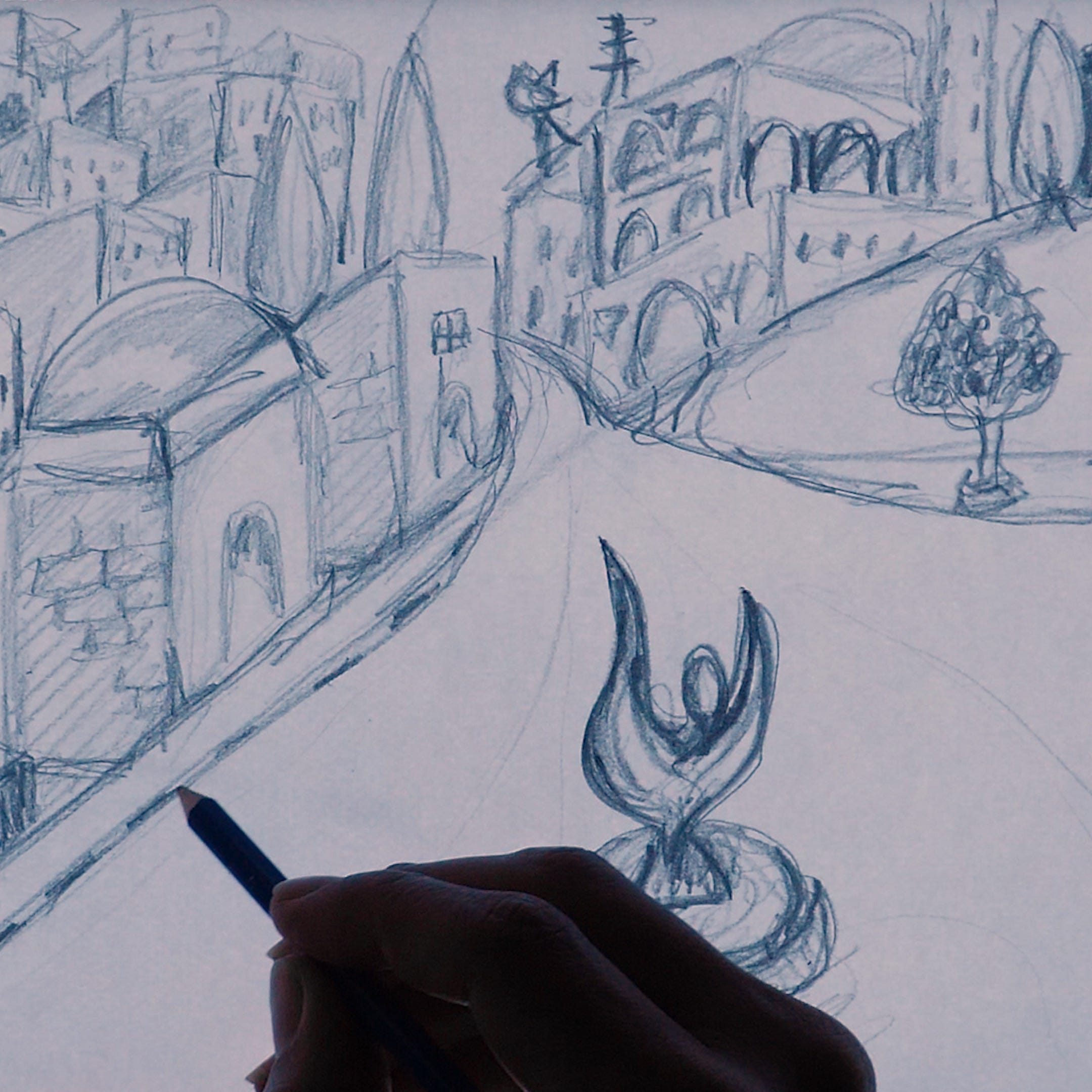
Abbas: It’s interesting that the film grew out of a single afternoon test. Throughout the film, we mostly see Mohammed’s hands and pencil lines, and hear his voice. Did you have this approach in mind from the beginning? During filming or editing, was there a particular memory or drawing that made you change the direction of the film?
Florinda: I had this approach in mind from the beginning. I thought it was an interesting artistic premise to create a form of resistance against the destruction of streets and buildings through only focusing on the act of drawing and storytelling, and the creation of an image. In my work, I often explore the effects of digital overstimulation on our memories, our ability to read images and our sensitivity towards them. So, for me, it was also a moment to explore the question of what an image actually is. If we have become, to a certain extent, emotionally disconnected from the constant stream of digital images, what happens when we bring an image back to just a few lines and sketches on a piece of paper, accompanied by a personal story? Does it allow us to feel something again? I was also interested in the meditative quality of drawing and how it could help create a deeper emotional connection. I find drawing to be a very internal experience, one that requires a certain degree of concentration and presence, which I found very fitting with this film. I felt that this approach was also a way of honoring the fact that this was Mohammed’s story to tell, not mine and it gave him the space to tell it and reconstruct these places himself, in his own way. There wasn’t one particular memory or drawing that changed the direction of the film. Rather, throughout the process, I was constantly aware of the kinds of questions I needed to ask him to translate it into a cinematic experience. I wanted to encourage him to focus not only on the physical appearance of these places, but also on their sensory qualities: the sunlight, the sounds of people in the street, the atmosphere, the feeling of being there. I felt these sensory cues were essential because they would allow the viewer’s imagination to become part of the experience. Rather than simply showing what a place looked like, I wanted the film to create the conditions for the viewer to imagine what it might have felt like to be there.
Abbas: I’d like to return to the drawings themselves. Where are they now? Are there plans to preserve or exhibit them as a separate collection? And do you and Mohammed hope to work together again?
Florinda: We were actually recently talking about how great it would be to make an exhibition with these particular drawings and others, together with the film, somewhere in the future. So stay tuned!
I would like to thank Florinda Ciucio for taking the time to speak with Souzian Dispatch and for sharing the story behind in memory of.
The film had its world premiere at DOK Leipzig 2026, where it screened in the International Competition Documentary Film and received the Silver Dove Short Film Award.
More About the Film
The 14-minute Belgian documentary follows Mohammed Alimrani, a Palestinian artist living in France, as he draws streets, houses and familiar places in Gaza from memory. Through his drawings and personal stories, the film recalls everyday life in a city transformed by war.
Festival Screenings and Awards
in memory of screened at DOK Leipzig between 28 October and 1 November 2026. It is also scheduled to screen at the 43rd Kasseler Dokumentarfilm- und Videofest on 19 and 20 November 2026.
Award
Silver Dove Short Film, International Competition Documentary Film, DOK Leipzig 2026. The €1,500 award is presented with the support of the Independent Saxon State Media Agency (SLM).
License
This piece, published by Souzian Dispatch and written by Abbas Souzian, is licensed under the Creative Commons Attribution-ShareAlike 4.0 International License (CC BY-SA 4.0), unless otherwise noted.
Images & Videos Credits and Rights
Certain images and videos included in this piece are not owned by Abbas Souzian or Souzian Dispatch and are not covered by this license. Rights to those materials remain with their respective copyright holders.