


My first encounter, as a film critic living somewhere other than Armenia, the distant homeland of my ancestors, with Marlene Edoyan’s A Fire There was something like the joy of flying toward a land that, despite having experienced so little of it, I feel deeply attached to.
Marlene Edoyan, too, lives far from Armenia, her ancestral homeland. I saw both myself and the filmmaker somewhere in the distance, at that same family table at the end of the film, in a place between leaving and staying, amid traditional Armenian songs, the rituals and customs of preparing and sharing food, glasses of alcohol, and the twilight of migration.
There were the deeply wrinkled faces of people who have lived through another era, people for whom home is not an abstract idea as it is for the young people in the film. Beyond matters of film criticism and analysis, this film is, for me, a strange and shifting work, shaped by the lovestruck fervor and clarity of its filmmaker, Marlene Edoyan.
For the Armenian diaspora, the homeland has always meant something different from what it means to those who live in Armenia. For those of us living outside it, the homeland appears in different forms throughout our everyday lives.
Sometimes its memory is bitter and piercing, sometimes nostalgic, sometimes entirely political. It can emerge in a note from Komitas’s music1, in Serj Tankian’s cries2, in the loving sound of a duduk, in a recitation by Charles Aznavour3, or in a shot from Sergei Parajanov4.
There are even days when we feel no particular emotion or sensitivity toward it. There is our attachment to our ancestral land, the conflict between Armenian identity and the country we have chosen to live in outside Armenia, or that our parents or grandparents chose for whatever reason in the past, and the linguistic and cultural duality that sometimes creates serious difficulties. Even returning to Armenia, whether as tourists or to live there, brings another duality: the Armenia we imagined and the Armenia that actually exists.
I think that in A Fire There, the filmmaker is trying to make the audience consider a question: for young Armenians who want to migrate, is identity necessarily something that can be carried in a backpack? When they encounter a new world, can they occasionally take it out for particular purposes, to resolve their difficulties? Or must they always keep it hidden so that life can settle more quickly into a normal rhythm in their self-chosen estrangement?
But the filmmaker examines the question of identity with even greater precision and care. From the perspective of her story and camera, identity is not only connected to the past and ethnic roots. It is also tied to poverty during migration, to encountering an unfamiliar language after moving away, to family memories and traditions, and to choices about the future made in the course of migration.
This is also why the story of A Fire There could not have taken place in Yerevan, the capital. Today, in 2026, relationships, culture, ways of thinking, and the very process of detaching oneself and leaving are far more modern there, and perhaps marked by a milder sentimentality, than in a place such as Gandzani, a village in the Javakheti region of southern Georgia.
The filmmaker places the concerns of two generations opposite each other and asks an important question: to be Armenian and remain Armenian, must one necessarily live in Armenia?
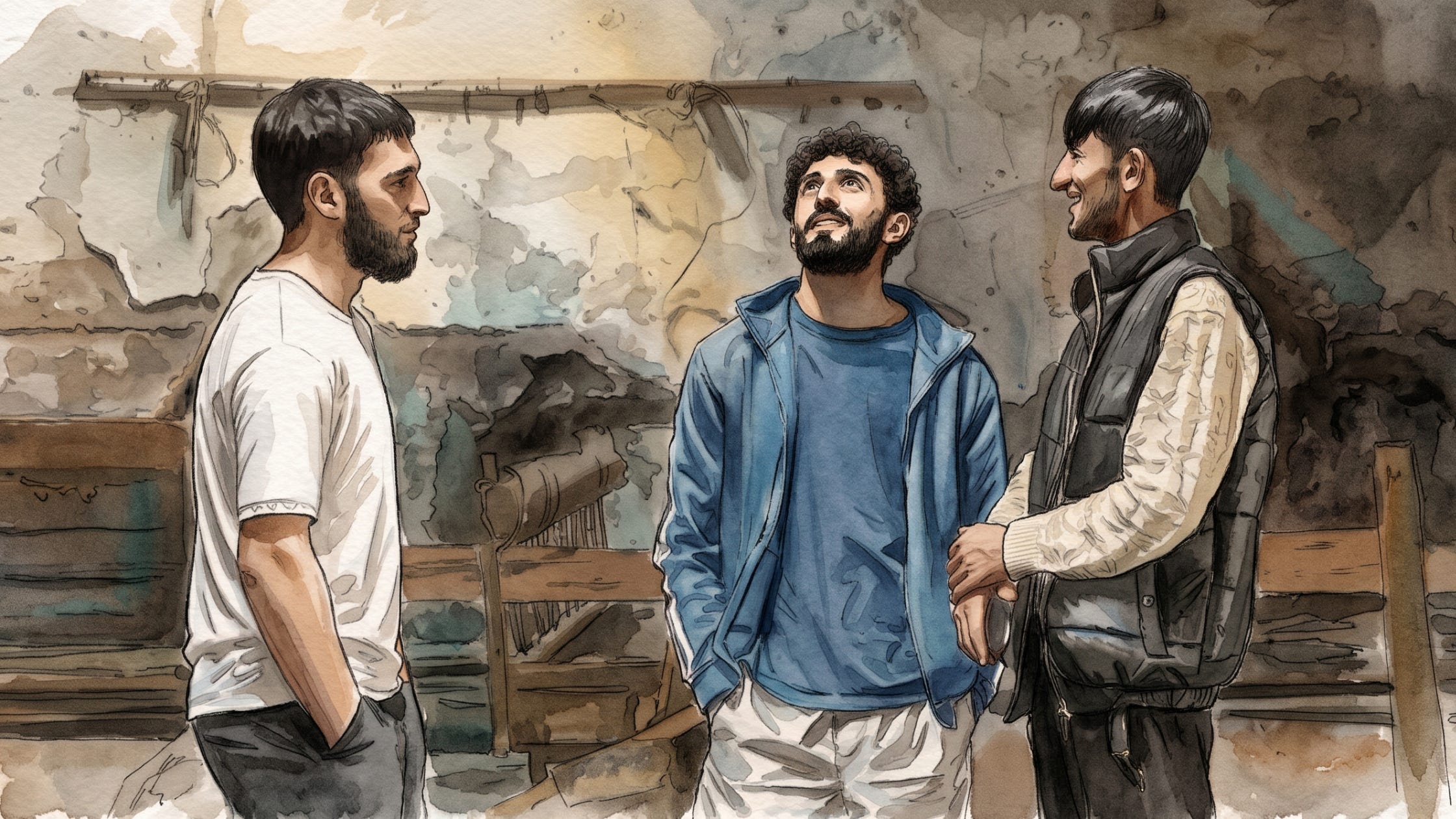
The film’s three central characters each have their own preoccupations. Henrikh is interested in education and political activity. Karlen is caught between staying and accepting family responsibilities, and migrating to Russia to improve his financial situation. Hakob, perhaps the most deeply rooted in local life, is not yet ready to sever his attachments. Yet alongside his two friends, questions slowly begin to arise for him.
Hakob is the inheritor of a legacy he does not want to forget, because it is part of his identity. Instead, he is searching for his own place within that heritage, and perhaps more than the other two, he wants to reconsider what his identity and inheritance mean to him.
Another aspect of the filmmaker’s perspective is the atmosphere of war, which is not so far away. Ukraine and its war run through the film, and watching news of the war on television has become part of everyday life, even though the characters do not face the war directly.
From another angle, there is Henrikh, who travels to Tbilisi and finds himself at the heart of political struggles. As a supporter of democracy, he returns to his birthplace and talks with his friends about a progressive world.
The filmmaker turns the war in Ukraine into one of the film’s political and historical backdrops, using it to bring out the differences in the characters’ viewpoints. Within the documentary, this means the characters do not simply speak about the war in clichés. Instead, as they talk with one another, their concerns, contradictions, and choices give the discussion greater depth.
Their conversations, whether in the forest or in an abandoned Soviet-era dairy factory, range from politics and work in Russia to attachment to Armenian identity and the war in Ukraine, and expand into a kind of geopolitical anxiety.
All these issues, with the war perhaps the most urgent matter in the background, make the three characters reconsider the decisions they are about to make.
Yet amid all these events, the filmmaker’s camera continually records something more important within the documentary: everyday work as a cultural ritual, celebrations, the church and Gregorian religious rites, the dining table, and the arrangement of different generations around that table.
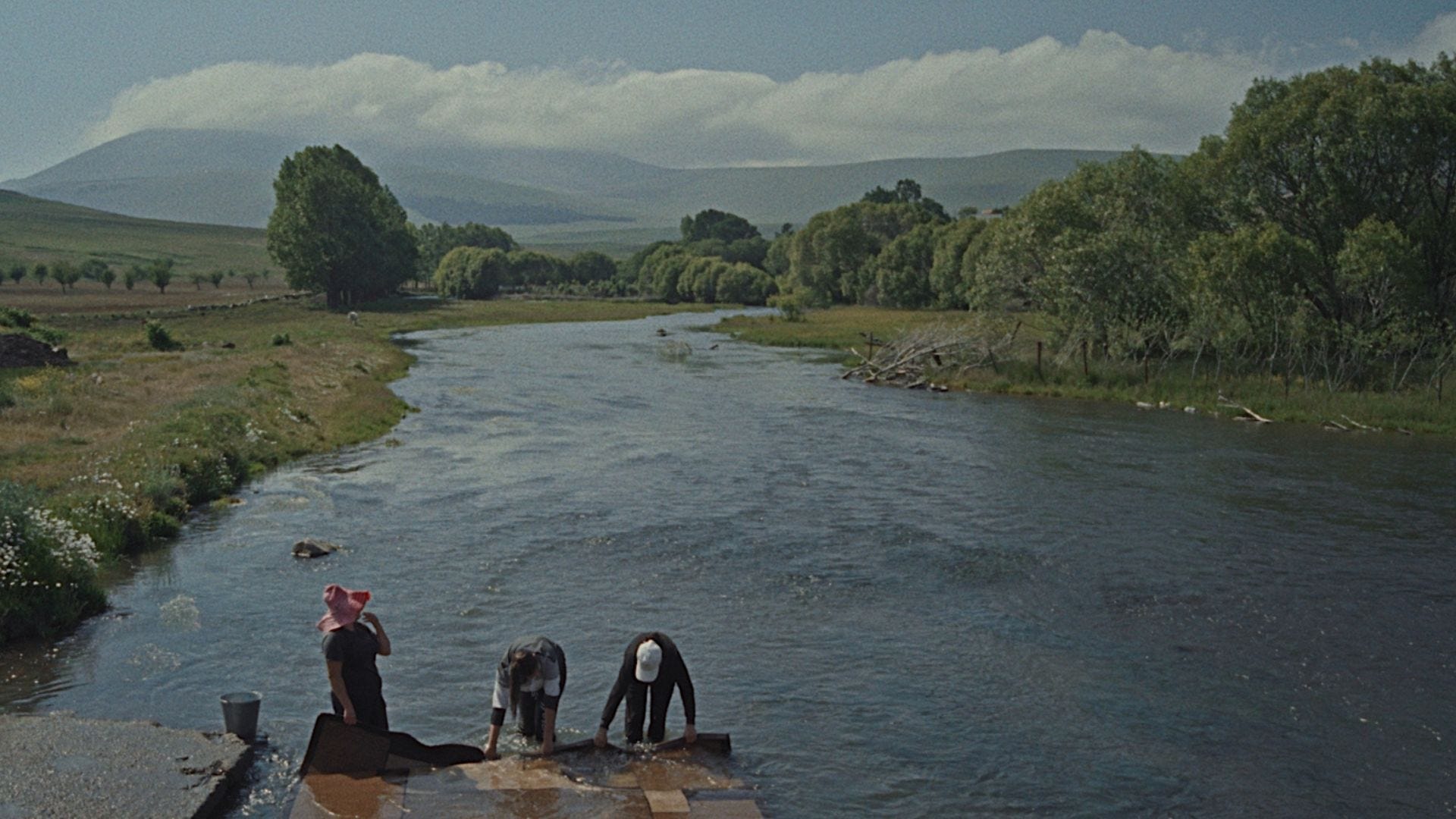
Recording all this could have produced a misunderstanding of the image, as in the films of Theo Angelopoulos: turning life into a postcard. But the film’s cinematographer, Étienne Roussy, avoids artificially beautifying the village and making it look like a tourist postcard.
He keeps the film grounded in its documentary setting while following the characters’ mental and emotional tensions. By pausing for the right amount of time on the characters and events, and by choosing the right framing, he allows the physical details of work in the village to be conveyed properly alongside speech and the relationships between the characters.
Showing the villagers in relation to their homes, the land, nature, abandoned modernity, and animals creates a comprehensible visual and geographical identity. It becomes the distinctive mark of that sense of identity, allowing us to say that the village itself is now an independent character within which the drama takes shape.
I would also like to point out that, although the film’s visual form reminded me of images from films by Andrei Tarkovsky and Andrey Zvyagintsev, one of the strengths of Marlene Edoyan’s film is that it does not imitate either filmmaker.
What is especially interesting about the articulation of the film’s images is the way it makes everything seen within the camera’s frame its own.
In a visual comparison of Tarkovsky and Edoyan, the image as memory and dream moves in two entirely familiar yet opposing directions, guided by two separate ways of thinking. Edoyan maintains the independence of the image from her story’s narrative, while for Tarkovsky, too, an image is not usually simply a means of narrating a dramatic event.
Likewise, in comparison with Zvyagintsev, Edoyan uses rural landscapes and everyday life, through calm shots and precise compositions, to reveal the political and social world of her characters.
Zvyagintsev, however, in The Return, places human beings against the mystery and silence of nature. In The Return, landscape often conveys a feeling of the breakdown of relationships or a moral crisis, or intensifies a powerful sense of loneliness.
In Edoyan’s film, the landscape does not serve this function, and… Cut!
About the Film
A Fire There (2026), directed by Marlene Edoyan, follows three young Armenian men in the village of Gandzani in southern Georgia as they navigate questions of identity, migration, family responsibilities and political uncertainty.
The Canadian documentary won the Special Jury Award at Visions du Réel 2026 in Switzerland and was presented at the Golden Apricot Yerevan International Film Festival 2026.
The film is also part of the Doc Alliance section at DOK Leipzig 2026, where it is scheduled for its German premiere, with screenings on 27 and 31 October.
Official Film Page: https://www.dok-leipzig.de/en/film/fire-there/programm
Komitas Vardapet
Soghomon Gevorgi Soghomonian, known as Komitas Vardapet, was a clergyman, music theorist, composer, conductor, musician, musicologist, Kapellmeister, and educator.
If there is one name that represents Armenian music, it is undoubtedly Komitas. As a child, he lost his parents and experienced homelessness and life in an orphanage.
In 1915, at the height of his fame and artistic creativity, he was arrested and deported by the Ottoman Empire. He survived the Armenian Genocide but was never able to return to a normal life and spent the rest of his years in psychiatric institutions.
Serj Tankian
Serj Tankian (also rendered as Tenkian) is an Armenian-American singer, songwriter, composer, musician, music producer, poet, and political activist, best known as the singer, songwriter, and musician of the metal band System of a Down.
Charles Aznavour
Shahnour Vaghinag Aznavourian, known as Charles Aznavour, was born on 22 May 1924 in the Latin Quarter of Paris (although the Armenian Genocide Museum-Institute identifies his birthplace as the Saint-Germain-des-Prés neighborhood of Paris) to Armenian immigrant parents who had fled their country because of the Armenian Genocide and sought refuge in Paris.
Sergei Parajanov
Sarkis Hovsepi Parajanian, known as Sergei Parajanov, was born on 9 January 1924 in Tbilisi, Georgia, to Armenian parents with artistic talents and interests.
His father, Iosif Parajanian, was a merchant and actor, and his mother, Siranush Bejanova, was also an actress.
In 1945, while still a young man, he moved to Moscow and enrolled at the Gerasimov Institute of Cinematography, one of the most respected film schools, where he studied under Alexander Dovzhenko and Igor Savchenko.
